Four problems are hitting the Pacific at the same time. The sea is rising. Cyclones are getting stronger. The ocean is warming and turning more acidic. And health systems are picking up the pieces from all three.
Any one of them would be a hard but solvable problem. Together, on countries with small budgets and almost no spare land, they are something else.
Here is what is actually going on, which islands sit closest to the edge, and what governments and households are doing about it.
Who This Is For
Read this if you live in the region and are making decisions about property, water storage or moving. Read it if you have family in Tuvalu or Kiribati and you are following visa ballots. Read it if you are planning a trip and want to know whether the weather has genuinely changed. Or read it if you just want a clear briefing without wading through a research paper.
The Four Main Climate Risks
Most Pacific communities live a short walk from the water. That single fact explains why a change in the ocean turns into a change in daily life so fast.
Rising Seas and Salt in the Drinking Water
Sea level rise is the big one, and a chunk of it is already locked in. NASA’s sea level team put it bluntly: Tuvalu, Kiribati and Fiji will get at least 15 centimetres of rise in the next 30 years no matter what happens to emissions in the near term.
But the flooding gets more attention than the thing that actually forces people out.
Coral atolls sit on a thin lens of fresh groundwater. Salt water pushes into it. Once that happens the water is no good for drinking, and the soil stops growing taro and breadfruit. Households fall back on rain tanks and imported food, so a long dry spell stops being an inconvenience and becomes an emergency.
Parts of Tuvalu that see fewer than five high-tide flood days a year could average 25 by the 2050s. In some parts of Kiribati the figure is closer to 65.
Cyclones That Cost More Than the Economy Earns
Warmer water feeds stronger storms, and small economies cannot absorb repeated hits.
One severe cyclone can take out roads, jetties, clinics and school roofs in a night, all of which need rebuilding with imported materials and often imported labour. Recovery from one storm regularly runs into the next season before it finishes.
The slower damage shows up in prices. Tour operators lose bookings. Insurers raise premiums or stop writing coastal policies. Banks get nervous about lending against shoreline property. Plenty of people are already paying for climate change through the cost of living, long before water reaches their front step.
A Warming Ocean Hits Food and Income Together
For most of these countries, the ocean is the economy. Fishing licences pay for schools. Reef fish feed families. Divers fill hotel rooms.
Marine heatwaves bleach reefs, and a bleached reef holds fewer fish and attracts fewer tourists. Acidification makes it harder for reef-building species to form shells and skeletons in the first place. On top of that, warming water is pushing tuna stocks eastward, which puts the licensing revenue several governments run on at risk.
There is a knock-on effect that rarely gets mentioned. When reef catch drops, families switch to cheap imported processed food, and that shift has driven serious long-term health problems across the region.
Health Systems Take the Strain
Standing floodwater and higher temperatures widen the range of mosquitoes carrying dengue. Contaminated water after a flood spreads diarrhoeal illness. Heat affects outdoor workers and older residents first. None of this makes headlines, but it lands on health services that are already spread thin across scattered islands with limited staff.
Which Pacific Islands Are Worst Affected?
Low-lying coral atoll nations face the sharpest risk, because there is nowhere higher to go.
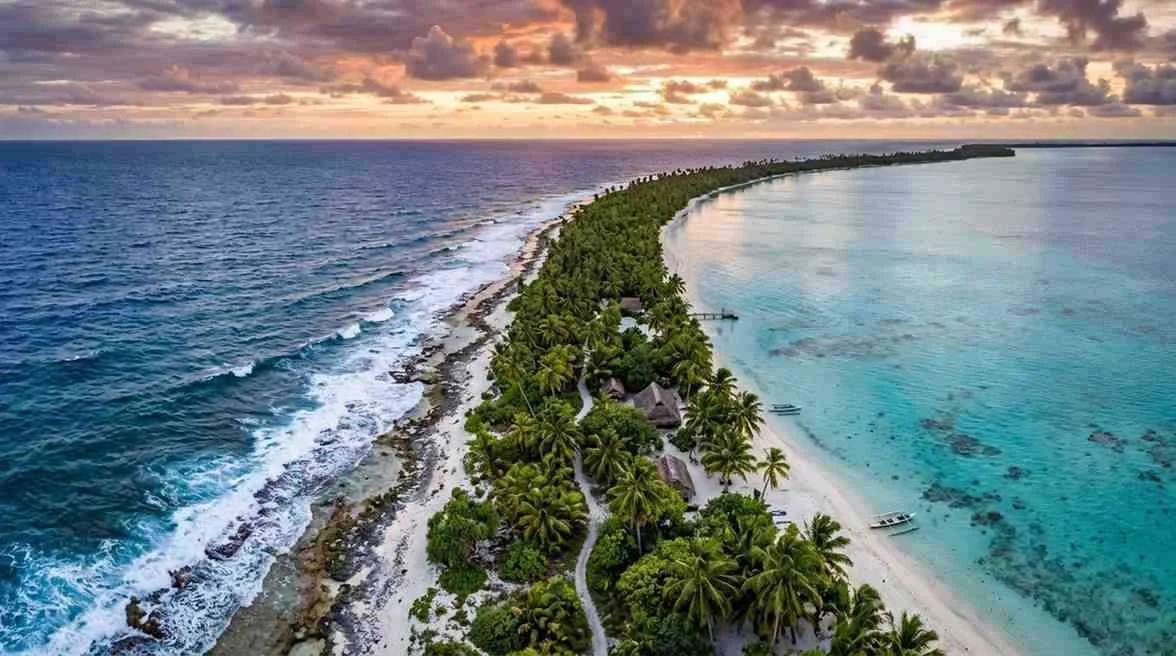
Tuvalu, Kiribati, the Marshall Islands and parts of the Federated States of Micronesia sit around two metres above sea level. The World Bank has warned that big portions of their main urban areas could go under within decades on current projections.
Fiji, Vanuatu, Solomon Islands, Samoa and Tonga are in a different category. They have volcanic interiors and higher ground, so moving inland is at least possible, and some communities in Fiji, Solomon Islands and Papua New Guinea have already done it. Their problem is cyclone intensity, not disappearance.
That gap matters more than it sounds. A country with mountains has an expensive adaptation problem. A country without them has a question about whether it still exists in a century.
What Pacific Nations Are Doing About It
Four things are running at once, and each one targets a different piece of the problem.
Building defences, and building new land. Tuvalu’s coastal adaptation work has reclaimed raised ground designed to sit above projected flood levels, giving the country somewhere to put housing that the current shoreline cannot safely hold. Elsewhere it looks like sea walls, elevated buildings, desalination units and mangrove replanting. Mangroves are quietly one of the better options, since they soak up wave energy and act as fish nurseries at the same time.
Locking in statehood legally. In July 2025 the International Court of Justice issued an advisory opinion confirming that countries have real legal obligations on climate change, and that failing to act can amount to a wrongful act under international law. The case started with law students at the University of the South Pacific in Fiji and was carried to the UN by Vanuatu. One finding mattered enormously to the region: the Court reasoned that statehood and existing maritime boundaries are not automatically lost to rising seas. That protects fishing zone revenue and national identity even in the worst scenarios.
Opening migration routes early. Australia and Tuvalu signed the Falepili Union in 2023, in force since August 2024. It gives up to 280 Tuvaluans a year permanent residence in Australia through a random ballot, with the right to travel back and forth. The first ballot drew registrations covering roughly a third of the population within days. The cap is deliberate. Moving everyone at once would gut the workforce long before the sea did, so spreading it across decades keeps the country running while families still get a legal way out.
Backing up the culture. Tuvalu started scanning its islands and building virtual government systems in 2022, aiming to keep records, culture and administration intact if the physical territory becomes unlivable.
The Bottleneck Is Money, Not Ideas
Pacific governments generally know what needs building. Getting hold of the funds is the hard part.
International climate finance tends to demand long technical applications, detailed documentation and reporting capacity. A country with a small civil service and a dozen urgent priorities is competing for the same pot as far larger applicants. Tuvalu has reported roughly a quarter of its government positions sitting empty. That is why the region keeps pushing for simpler, direct-access funding. A grant that takes four years to clear does not help a village that floods every king tide.
What You Can Actually Do
Living in the region: check whether your land sits in a mapped coastal inundation zone before you renovate or buy, make sure household water storage covers a full dry season, and sign up for national early warning alerts.
Family in Tuvalu or Kiribati: follow ballot windows through the official Australian and New Zealand immigration pages rather than social media. The windows are short, and registration costs far less than the visa stage that follows.
Travelling: cyclone season runs roughly November to April, so plan around it and buy insurance that spells out weather disruption cover. Our guide to reading seasonal travel windows covers how to do that properly.
Following it from outside: the pre-COP meetings are set for Fiji and Tuvalu ahead of COP31 in Antalya in November 2026, with Australia chairing negotiations. Pacific demands on adaptation finance will be tested there.
More regional coverage sits in our Oceania section, and Happiest Countries 2026 has useful context on how livability gets measured.
Frequently Asked Questions
Will Pacific islands disappear completely?
Some atolls will become unlivable well before they physically vanish, because the drinking water turns salty and crops fail while there is still land above water. Higher volcanic islands like Fiji and Vanuatu are not going anywhere, though their coastlines will look different.
Which Pacific island is most affected by climate change?
Tuvalu and Kiribati, on most measures. Both sit around two metres above sea level with no high ground, and both already deal with regular high-tide flooding and salt contamination of their fresh water.
Can Pacific islanders move to Australia because of climate change?
Only through specific programmes. Tuvaluans can enter the Falepili Mobility Pathway ballot, which grants 280 permanent residence places a year. Other Pacific nationals can apply for the Pacific Engagement Visa. There is no general climate refugee visa, and refugee law does not currently treat climate displacement as grounds for asylum.
Is it safe to travel to Pacific islands right now?
Yes. Tourism runs normally in Fiji, Samoa, Tonga, Vanuatu and the Cook Islands. Timing is the real consideration, given the November to April cyclone season, and insurance covering weather cancellation is worth having in those months.
Why are these countries so vulnerable when they emit so little?
It comes down to geography rather than emissions. Their contribution to global emissions is a fraction of a percent, but nearly everything they own sits near the coast, their economies lean on a few climate-sensitive sectors, and small populations mean limited resources for big defensive works.
What did the 2025 ICJ opinion change?
It confirmed that countries have legal obligations to prevent climate harm and can be held responsible for inaction, and it indicated that statehood and maritime boundaries would not automatically be lost to sea level rise. The opinion is not binding, but it gives Pacific nations firmer ground in negotiations and future litigation.
How can I support Pacific climate adaptation?
Back organisations working on water security, mangroves and coastal defence in the region. Pick tour operators that fund local reef and community projects. And follow Pacific-led campaigns rather than outside ones, since these governments have been setting their own priorities for a long time.