📐 Geometry Formulas: Calculator + Reference
Interactive calculator + complete formula reference — all in one page
Select a Shape
📏 2D Shapes — Area & Perimeter
📦 3D Shapes — Volume & Surface Area
📐 Essential Theorems & Rules
📝 Quick Reference — Most Common Formulas
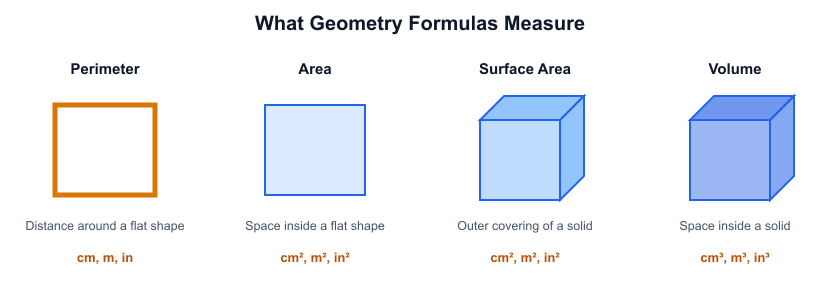
Geometry formulas are the rules that turn the measurements of a shape into its size. They give you four things: perimeter (distance around a flat shape), area (space inside a flat shape), surface area (outer covering of a solid), and volume (space inside a solid). Everything below is grouped by shape and by grade level, so you can find one formula in ten seconds or revise all of them in one sitting.
Most students do not fail geometry because the formulas are hard. They fail because they pick the wrong one, or they write the right number with the wrong unit. This page fixes both problems.
What Are Geometry Formulas?
Geometry formulas are short equations that calculate the dimensions, perimeter, area, surface area or volume of a shape using its known measurements. Each formula uses a small set of letters for lengths, and the same four quantities appear again and again.
Geometry splits into two families:
- Plane geometry (2D): flat shapes with length and width only. Squares, circles, triangles, quadrilaterals, polygons.
- Solid geometry (3D): objects with length, width and height. Cubes, cylinders, cones, spheres, prisms, pyramids.
A third family, coordinate geometry, measures shapes plotted on x and y axes. It appears from grade 9 onward and has its own set of formulas listed later on this page.
Who Needs Which Geometry Formulas, by Class and Grade
You do not need all geometry formulas at once. Curricula introduces them in a fixed order. Find your row, learn that set, and ignore the rest until later.
| Class / Grade | Curriculum reference | Formulas you need |
|---|---|---|
| Class 4 to 5 (Grade 4 to 5) | CCSS 4.MD.3, NCERT Class 4-5 | Perimeter and area of square and rectangle |
| Class 6 (Grade 6) | CCSS 6.G.1, NCERT Class 6 Ch 10 | Area of triangle and parallelogram, perimeter of any polygon |
| Class 7 (Grade 7) | CCSS 7.G.4, 7.G.6, NCERT Class 7 Ch 11 | Circumference and area of circle, area of trapezium, area of rhombus |
| Class 8 (Grade 8) | CCSS 8.G.7, 8.G.9, NCERT Class 8 Ch 9 and 11 | Pythagoras theorem, surface area and volume of cube, cuboid, cylinder |
| Class 9 (Grade 9) | CCSS G.GMD, NCERT Class 9 Ch 9, 10, 12 | Heron’s formula, cone, sphere, hemisphere, circle theorems, coordinate distance |
| Class 10 (Grade 10) | CCSS G.GPE, NCERT Class 10 Ch 6, 7, 11, 12 | Similar triangles, section formula, sector and segment area, combined solids |
| Class 11 to 12 (Grade 11 to 12) | NCERT Class 11 Ch 10-12, Class 12 Ch 11 | Straight lines, conic sections, 3D coordinate geometry, direction cosines |
Competitive exams pull from the whole table. The SAT provides a small reference sheet with circle, triangle and volume formulas but expects you to know the rest. GCSE and NCERT board exams provide almost nothing, so treat every formula here as memorization work.
How Geometry Formulas Work: The Four Quantities
Every geometry formula answers one of four questions, and each answer carries its own unit. Identify the question first, then the unit tells you instantly whether your formula was right.
| What you are measuring | Shape type | Formula family | Unit of the answer |
|---|---|---|---|
| Distance around the outside | 2D | Perimeter (circumference for circles) | cm, m, in |
| Space inside a flat shape | 2D | Area | cm², m², in² |
| Outer covering of a solid | 3D | Surface area (CSA, LSA or TSA) | cm², m², in² |
| Space inside a solid | 3D | Volume | cm³, m³, in³ |
Three surface area terms cause most of the confusion:
- LSA (lateral surface area): the side faces only, no top or bottom.
- CSA (curved surface area): the curved part only, used for cylinders, cones and hemispheres.
- TSA (total surface area): every face added together, including bases.
Unit conversion warning: raise the conversion factor to the same power as the unit. 1 m = 100 cm, so 1 m² = 10,000 cm² and 1 m³ = 1,000,000 cm³. Also useful: 1 litre = 1,000 cm³.
Variable Key: What the Letters Mean
Read this key once and the rest of the page becomes readable. These letters stay consistent throughout.
| Symbol | Meaning |
|---|---|
| a, b, c | Sides of a shape (c is the hypotenuse in right triangles) |
| s | Side length when all sides are equal, or semi-perimeter in Heron’s formula |
| l, w, h | Length, width, height |
| b, h | Base and perpendicular height (triangles, parallelograms, trapeziums) |
| r, R | Radius (R is the larger radius in rings and frustums) |
| d | Diameter, or d₁ and d₂ for diagonals |
| l (in cones) | Slant height |
| P, A, V | Perimeter, area, volume |
| π | Pi, approximately 3.14159 or 22/7 |
| θ | Angle, in degrees or radians as stated |
Basic Geometry Formulas Everyone Should Know
These ten formulas cover roughly 80% of school geometry questions. Learn these before anything else on this page.
| Shape | Formula |
|---|---|
| Square | Perimeter = 4a, Area = a² |
| Rectangle | Perimeter = 2(l + w), Area = l × w |
| Triangle | Area = ½ × b × h |
| Circle | Circumference = 2πr, Area = πr² |
| Right triangle | a² + b² = c² |
| Cube | Volume = a³, TSA = 6a² |
| Cuboid | Volume = l × w × h, TSA = 2(lw + wh + hl) |
| Cylinder | Volume = πr²h, TSA = 2πr(r + h) |
| Cone | Volume = ⅓πr²h |
| Sphere | Volume = ⁴⁄₃πr³, Surface area = 4πr² |
Geometry Formulas for 2D Shapes
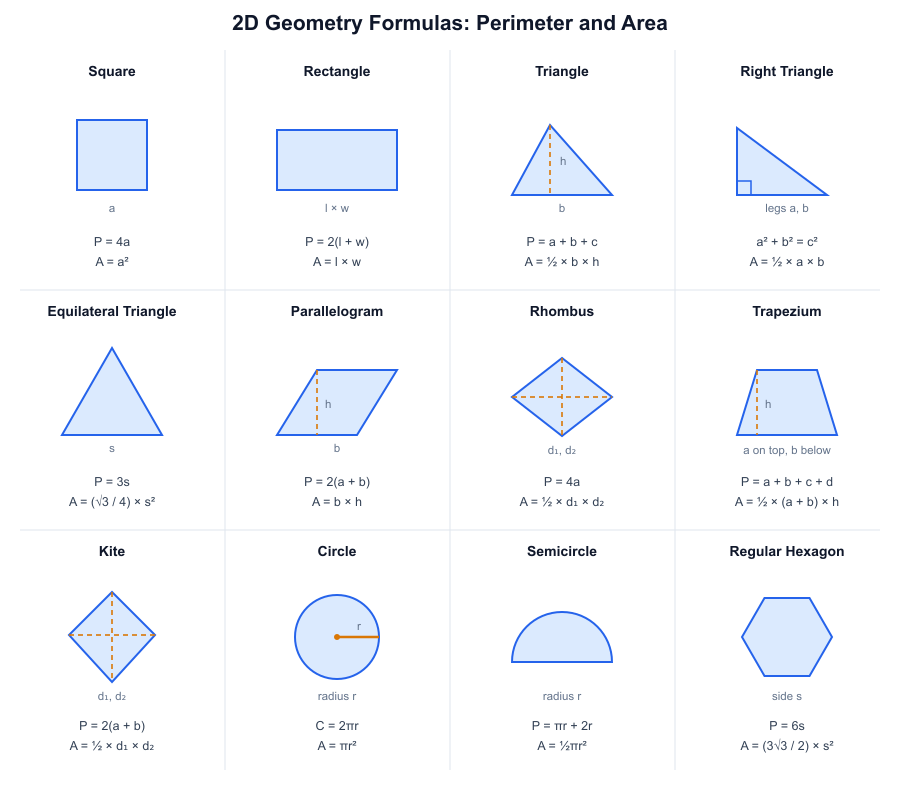
Flat shapes need two formulas each: perimeter and area. The table gives the full set, and the notes below it cover the cases that trip people up.
| Shape | Perimeter | Area |
|---|---|---|
| Square | 4a | a² |
| Rectangle | 2(l + w) | l × w |
| Triangle (general) | a + b + c | ½ × b × h |
| Right triangle | a + b + c | ½ × a × b (legs a and b) |
| Equilateral triangle | 3s | (√3 / 4) × s² |
| Isosceles triangle | 2a + b | ½ × b × h |
| Parallelogram | 2(a + b) | b × h |
| Rhombus | 4a | ½ × d₁ × d₂ |
| Trapezium (trapezoid) | a + b + c + d | ½ × (a + b) × h |
| Kite | 2(a + b) | ½ × d₁ × d₂ |
| Circle | 2πr or πd | πr² |
| Semicircle | πr + 2r | ½πr² |
| Ellipse | ≈ π[3(a + b) − √((3a + b)(a + 3b))] | πab |
| Regular polygon (n sides) | n × s | ½ × P × apothem |
| Regular hexagon | 6s | (3√3 / 2) × s² |
| Regular pentagon | 5s | ≈ 1.72 × s² |
Extra 2D Formulas Worth Knowing
- Square diagonal: d = a√2
- Rectangle diagonal: d = √(l² + w²)
- Equilateral triangle height: h = (√3 / 2) × s
- Isosceles triangle height: h = √(a² − b²/4), where a is an equal side and b the base
- Rhombus side from diagonals: a = ½ × √(d₁² + d₂²)
- Trapezium median: m = (a + b) / 2
- Regular polygon area from side length: A = (n × s²) / (4 tan(180°/n))
The Height Mistake in Parallelograms and Trapeziums
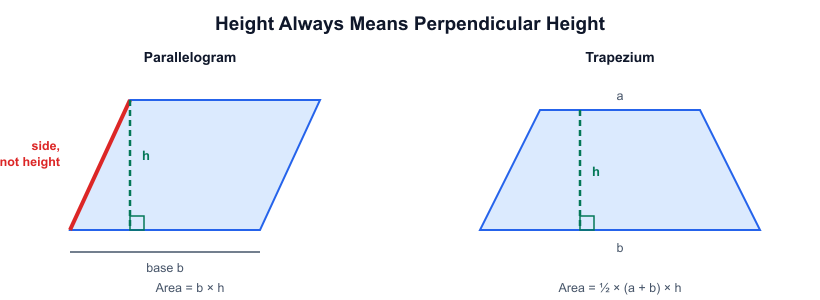
Height always means perpendicular height, never the slanted side. If a parallelogram has sides 8 cm and 5 cm with a slant, the 5 cm is a side, not the height. Drop a straight line from the top edge to the base and measure that instead. This single error accounts for a large share of lost marks in area questions.
Geometry Circle Formulas
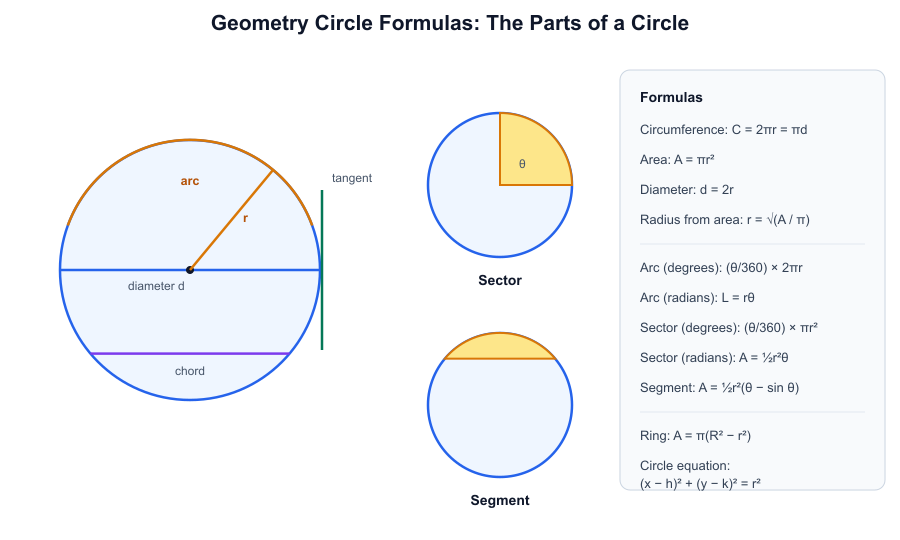
Circle formulas use only the radius, the diameter and the angle at the centre. Everything else is built from those three inputs.
| Measurement | Formula |
|---|---|
| Circumference | C = 2πr or C = πd |
| Area | A = πr² |
| Diameter | d = 2r |
| Radius from area | r = √(A / π) |
| Arc length (degrees) | L = (θ / 360) × 2πr |
| Arc length (radians) | L = rθ |
| Sector area (degrees) | A = (θ / 360) × πr² |
| Sector area (radians) | A = ½r²θ |
| Segment area (radians) | A = ½r²(θ − sin θ) |
| Semicircle area | A = ½πr² |
| Ring (annulus) area | A = π(R² − r²) |
| Equation of a circle | (x − h)² + (y − k)² = r², centre (h, k) |
Circle Theorems You Need Alongside the Formulas
Circle questions in grade 9 and 10 usually test a theorem, not a formula. These six cover most exam problems:
- The angle at the centre is twice the angle at the circumference standing on the same arc.
- Any angle in a semicircle equals 90°.
- A tangent meets the radius at 90° at the point of contact.
- Two tangents drawn from the same external point are equal in length.
- Opposite angles of a cyclic quadrilateral add to 180°.
- When two chords cross inside a circle, the products of their segments are equal.
Should You Use 22/7 or 3.14 for Pi?
Use 22/7 when the radius is a multiple of 7, and 3.14 otherwise. With r = 21, the fraction 22/7 cancels cleanly and gives exact-looking answers. With r = 5, use 3.14 or the π button on your calculator. Mixing the two inside one question produces answers that look almost right but fail the marking scheme.
Geometry Formulas for 3D Shapes
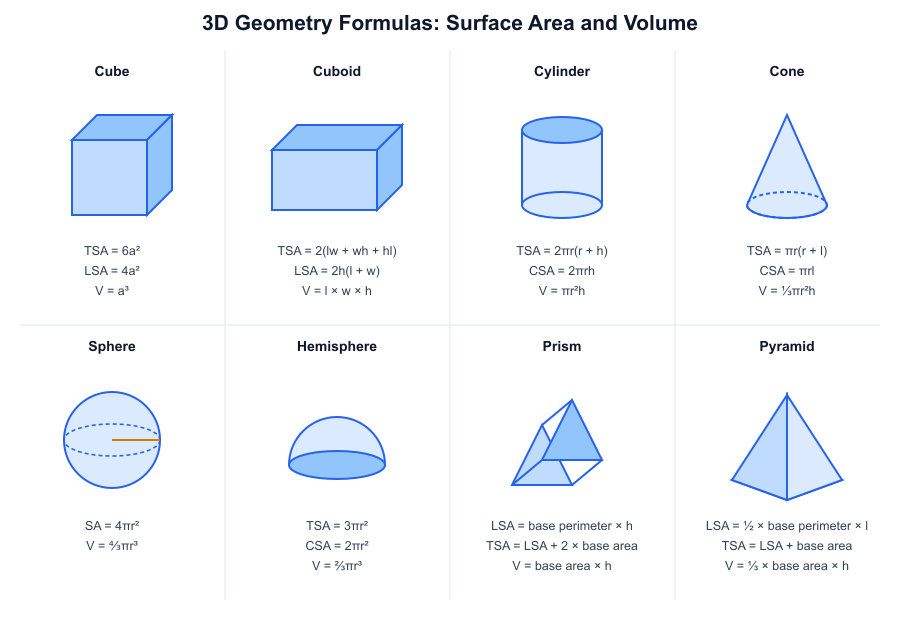
Solid shapes need three formulas each: curved or lateral surface area, total surface area, and volume.
| Shape | CSA / LSA | TSA | Volume |
|---|---|---|---|
| Cube | 4a² | 6a² | a³ |
| Cuboid | 2h(l + w) | 2(lw + wh + hl) | l × w × h |
| Cylinder | 2πrh | 2πr(r + h) | πr²h |
| Hollow cylinder | 2πh(R + r) | 2πh(R + r) + 2π(R² − r²) | πh(R² − r²) |
| Cone | πrl | πr(r + l) | ⅓πr²h |
| Sphere | not applicable | 4πr² | ⁴⁄₃πr³ |
| Hemisphere | 2πr² | 3πr² | ⅔πr³ |
| Prism (any base) | base perimeter × h | LSA + 2 × base area | base area × h |
| Pyramid (any base) | ½ × base perimeter × l | LSA + base area | ⅓ × base area × h |
| Square pyramid | 2bl | b² + 2bl | ⅓b²h |
| Frustum of a cone | πl(R + r) | πl(R + r) + πR² + πr² | ⅓πh(R² + Rr + r²) |
| Regular tetrahedron | not applicable | √3 a² | a³ / (6√2) |
| Torus | not applicable | 4π²Rr | 2π²Rr² |
Slant Height and Diagonals
You often have to calculate one measurement before you can use the main formula:
- Cone slant height: l = √(r² + h²)
- Square pyramid slant height: l = √(h² + (b/2)²)
- Frustum slant height: l = √(h² + (R − r)²)
- Cube space diagonal: d = a√3
- Cuboid space diagonal: d = √(l² + w² + h²)
Euler’s Formula for Solids
For any convex polyhedron: V − E + F = 2, where V is vertices, E is edges and F is faces. A cube checks out: 8 − 12 + 6 = 2.
Angle and Polygon Formulas
Angle formulas depend only on the number of sides, not on the size of the shape.
| Rule | Formula |
|---|---|
| Sum of interior angles of an n-sided polygon | (n − 2) × 180° |
| Each interior angle of a regular polygon | [(n − 2) × 180°] / n |
| Sum of exterior angles (any polygon) | 360° |
| Each exterior angle of a regular polygon | 360° / n |
| Number of diagonals | n(n − 3) / 2 |
| Angles in a triangle | add to 180° |
| Angles in a quadrilateral | add to 360° |
Quick check: a regular hexagon has interior angles of (6 − 2) × 180 / 6 = 120°, and 9 diagonals.
Coordinate Geometry Formulas
Coordinate geometry measures shapes using point positions instead of a ruler. These appear from grade 9 and dominate grade 11 and 12 papers.
| Formula name | Formula |
|---|---|
| Distance between two points | d = √[(x₂ − x₁)² + (y₂ − y₁)²] |
| Midpoint | M = ((x₁ + x₂)/2, (y₁ + y₂)/2) |
| Section formula (internal, ratio m:n) | ((mx₂ + nx₁)/(m + n), (my₂ + ny₁)/(m + n)) |
| Slope of a line | m = (y₂ − y₁) / (x₂ − x₁) |
| Slope-intercept form | y = mx + c |
| Point-slope form | y − y₁ = m(x − x₁) |
| Parallel lines | m₁ = m₂ |
| Perpendicular lines | m₁ × m₂ = −1 |
| Area of a triangle from coordinates | ½ |x₁(y₂ − y₃) + x₂(y₃ − y₁) + x₃(y₁ − y₂)| |
| Centroid of a triangle | ((x₁ + x₂ + x₃)/3, (y₁ + y₂ + y₃)/3) |
| Distance from a point to a line Ax + By + C = 0 | |Ax₁ + By₁ + C| / √(A² + B²) |
| Distance in 3D space | d = √[(x₂ − x₁)² + (y₂ − y₁)² + (z₂ − z₁)²] |
Triangle Formulas Beyond Area
When you do not know the height of a triangle, three other routes give you the area.
| Situation | Formula |
|---|---|
| All three sides known | Heron’s formula: A = √[s(s − a)(s − b)(s − c)], s = (a + b + c)/2 |
| Two sides and the angle between them | A = ½ab sin C |
| Right triangle, missing side | a² + b² = c² |
| Right triangle, angle and one side | sin θ = opposite/hypotenuse, cos θ = adjacent/hypotenuse, tan θ = opposite/adjacent |
| Any triangle, two angles and a side | Sine rule: a / sin A = b / sin B = c / sin C |
| Any triangle, three sides or two sides and included angle | Cosine rule: a² = b² + c² − 2bc cos A |
The three trigonometric ratios are usually remembered as SOH CAH TOA.
Similar Shapes: The Scale Factor Rules
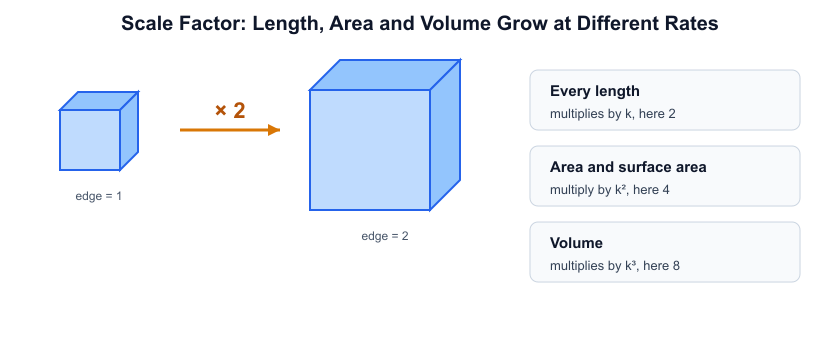
When one shape is an enlargement of another, lengths, areas and volumes scale at different rates. Miss this and you will multiply the wrong quantity.
If the length scale factor is k, then:
- Every length multiplies by k
- Every area and surface area multiplies by k²
- Every volume multiplies by k³
Example: double the dimensions of a cube and its surface area becomes 4 times larger while its volume becomes 8 times larger. This is why a large pizza is far more food than its price suggests.
Composite Shapes: What to Do When Your Shape Is Not Listed
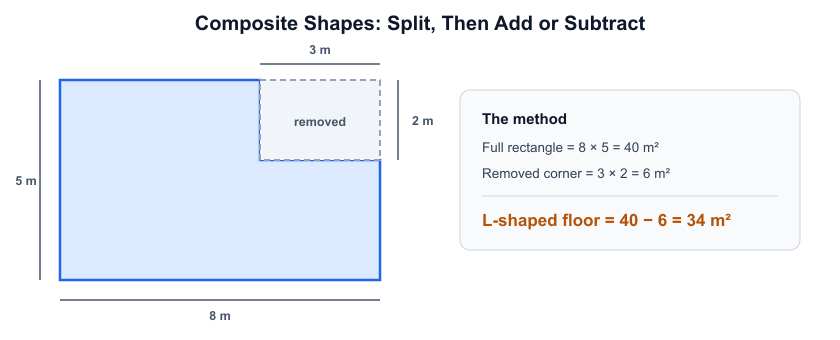
Break the shape into pieces you already have formulas for, then add or subtract. Almost every real object is a combination of basic shapes.
The method:
- Sketch the shape and split it with straight lines into rectangles, triangles, circles or standard solids.
- Write the formula for each piece.
- Add the pieces for a joined shape, subtract for a hole or cut-out.
- Check that every piece uses the same unit before you total them.
Common cases: an L-shaped room is two rectangles, a capsule is a cylinder plus two hemispheres, a silo is a cylinder plus a cone, and a washer is a circle minus a smaller circle.
Worked Examples Using Geometry Formulas
Example 1: Area and Circumference of a Circle
A circular tabletop has a radius of 21 cm. Find its area and circumference using 22/7 for π.
Area = πr² = (22/7) × 21 × 21 = 22 × 63 = 1,386 cm² Circumference = 2πr = 2 × (22/7) × 21 = 132 cm
Notice the units: area in cm², circumference in cm.
Example 2: Surface Area and Volume of a Cylinder
A water tank has a radius of 7 m and a height of 10 m. Find its curved surface area, total surface area and volume, using 22/7 for π.
CSA = 2πrh = 2 × (22/7) × 7 × 10 = 440 m² TSA = 2πr(r + h) = 2 × (22/7) × 7 × 17 = 748 m² Volume = πr²h = (22/7) × 49 × 10 = 1,540 m³
Example 3: Area of a Triangle with Three Sides Known
A triangular plot has sides of 13 m, 14 m and 15 m. No height is given, so use Heron’s formula.
s = (13 + 14 + 15) / 2 = 21 A = √[21 × (21 − 13) × (21 − 14) × (21 − 15)] A = √(21 × 8 × 7 × 6) = √7,056 = 84 m²
Example 4: Area of a Composite Shape
An L-shaped floor fits inside an 8 m by 5 m rectangle, with a 3 m by 2 m corner removed.
Full rectangle = 8 × 5 = 40 m² Removed corner = 3 × 2 = 6 m² Floor area = 40 − 6 = 34 m²
Example 5: Volume of a Cone
An ice cream cone has a radius of 3 cm and a height of 4 cm. Find its slant height, curved surface area and volume.
Slant height l = √(3² + 4²) = √25 = 5 cm CSA = πrl = π × 3 × 5 = 15π ≈ 47.12 cm² Volume = ⅓πr²h = ⅓ × π × 9 × 4 = 12π ≈ 37.70 cm³
Common Mistakes and How to Avoid Them
Five errors cause most lost marks in geometry. Check for these before you submit any answer.
| Mistake | Fix |
|---|---|
| Writing area in cm instead of cm² | Match the unit to the quantity: linear, square, cubic |
| Using the slanted side as the height | Height is always perpendicular to the base |
| Confusing radius with diameter | Halve the diameter before it enters any circle formula |
| Using CSA when the question asks for TSA | Read whether the base or lid is included, such as an open tank |
| Adding measurements in different units | Convert everything to one unit first |
An open cylindrical tank is the classic trap. It has no lid, so its surface area is 2πrh + πr², not 2πr(r + h).
How to Memorize All Geometry Formulas
Group formulas by pattern instead of learning them as a list of 40 unrelated items. Four patterns cover nearly everything:
- Volume of a prism-type solid = base area × height. This one rule gives you the cube, cuboid, cylinder and every prism.
- Volume of a pointed solid = ⅓ × base area × height. This gives you the cone and every pyramid.
- Anything with a curve carries π. If a formula has no π, the shape has no circular part.
- The ½ appears when a shape is half of a simpler one. A triangle is half a parallelogram, so its area is ½bh. A sector uses ½r²θ for the same structural reason.
After grouping, test yourself by writing the formulas from a blank page rather than rereading them. Recall builds retention; rereading only builds familiarity.
Frequently Asked Questions About Geometry Formulas
What are the basic geometry formulas?
The basic geometry formulas are area of a rectangle (l × w), area of a triangle (½ × b × h), area of a circle (πr²), circumference of a circle (2πr), Pythagoras theorem (a² + b² = c²), volume of a cube (a³), volume of a cuboid (l × w × h), and volume of a cylinder (πr²h). These eight cover the majority of middle-school questions.
What are all the geometry circle formulas?
Circumference = 2πr, area = πr², diameter = 2r, arc length = rθ in radians or (θ/360) × 2πr in degrees, sector area = ½r²θ in radians or (θ/360) × πr² in degrees, segment area = ½r²(θ − sin θ), and the equation of a circle is (x − h)² + (y − k)² = r².
Which geometry formulas do I need for Class 10?
Class 10 needs the full mensuration set (cone, sphere, hemisphere, cylinder, combined solids), sector and segment area, similar triangle ratios, the distance and section formulas from coordinate geometry, and circle theorems involving tangents.
What is the difference between area and surface area?
Area measures the space inside a flat 2D shape. Surface area measures the total outer covering of a 3D solid, which is the sum of the areas of all its faces. Both are written in square units.
How do I remember all geometry formulas?
Group them by pattern rather than by shape. Prism-type solids use base area × height, pointed solids use one third of that, and any shape with a curved edge includes π. Then practise writing them from memory on a blank sheet instead of rereading a chart.
Why is the area of a triangle half the base times the height?
A triangle is exactly half of a parallelogram with the same base and height. Cut a parallelogram along a diagonal and you get two identical triangles, so each one has half the area, giving ½bh.
What formula do I use for a shape that is not on the list?
Split it into shapes you do have formulas for. Add the parts for a combined shape and subtract for a cut-out. An L-shaped room is two rectangles, and a capsule is a cylinder plus two hemispheres.
Do I use 22/7 or 3.14 for pi?
Use 22/7 when the radius or diameter is a multiple of 7, because the fraction cancels neatly. Use 3.14 or your calculator’s π key in every other case. Never switch between them inside the same question.
Is Pythagoras theorem a geometry formula?
Yes. Pythagoras theorem (a² + b² = c²) is a geometry formula for right triangles, where c is the hypotenuse. It is also the foundation of the distance formula in coordinate geometry.
What happens to area and volume when a shape is enlarged?
If every length is multiplied by k, the area and surface area are multiplied by k², and the volume is multiplied by k³. Doubling the sides of a cube multiplies its volume by 8, not by 2.
Which geometry formulas are given in exams?
The SAT supplies a short reference sheet with circle, triangle and basic volume formulas. GCSE and NCERT board exams supply almost nothing, so plan to memorize the full list on this page.
What is the formula for the volume of all 3D shapes?
Cube = a³, cuboid = l × w × h, cylinder = πr²h, cone = ⅓πr²h, sphere = ⁴⁄₃πr³, hemisphere = ⅔πr³, prism = base area × height, and pyramid = ⅓ × base area × height.